 0:51
0:51
Snug-Tightened vs Pretensioned vs Slip-Critical Bolted Joints
Understand the difference between snug-tightened, pretensioned, and slip-critical structural bolted joints, and why the specified joint condition controls.
Welding-symbol explainer · 0:45
Learn the basic anatomy of an AWS welding symbol, including the arrow, reference line, arrow side, other side, dimensions, supplementary symbols, and tail.
Practical context
Under the AWS system, the weld symbol's position relative to the reference line identifies which side of the joint receives the specified weld.
An arrow pointing up or down still identifies the joint. Under AWS A2.4, placement above or below the reference line determines other-side or arrow-side significance.
Companion reading and practice
A training detail has several nearby joints and one welding symbol. Reading the size without following the arrow can attach the instruction to the wrong joint.
Identify the joint, then read the reference-line information, supplementary symbols, tail, and associated notes as applicable. Record the stated values without inventing missing instructions. AWS A2.4 provides the symbol system; the project documents establish which weld is required.
Annotate a sample detail with the referenced joint and a list of the instructions you can actually find.
Examples are fictional learning exercises. This companion text adds context to the video; the transcript below records the narration.
Primary sources
Use the edition and requirements adopted for the project. These references support further reading; a short video does not reproduce the complete standards.
Published by Quantum Steel Design. Sources and editorial approach · Report a correction · Companion guide updated .
Accessible transcript
The visible transcript makes the video content available to people and search systems without requiring playback.
Keep watching
0:51
Understand the difference between snug-tightened, pretensioned, and slip-critical structural bolted joints, and why the specified joint condition controls.
 10:34
10:34
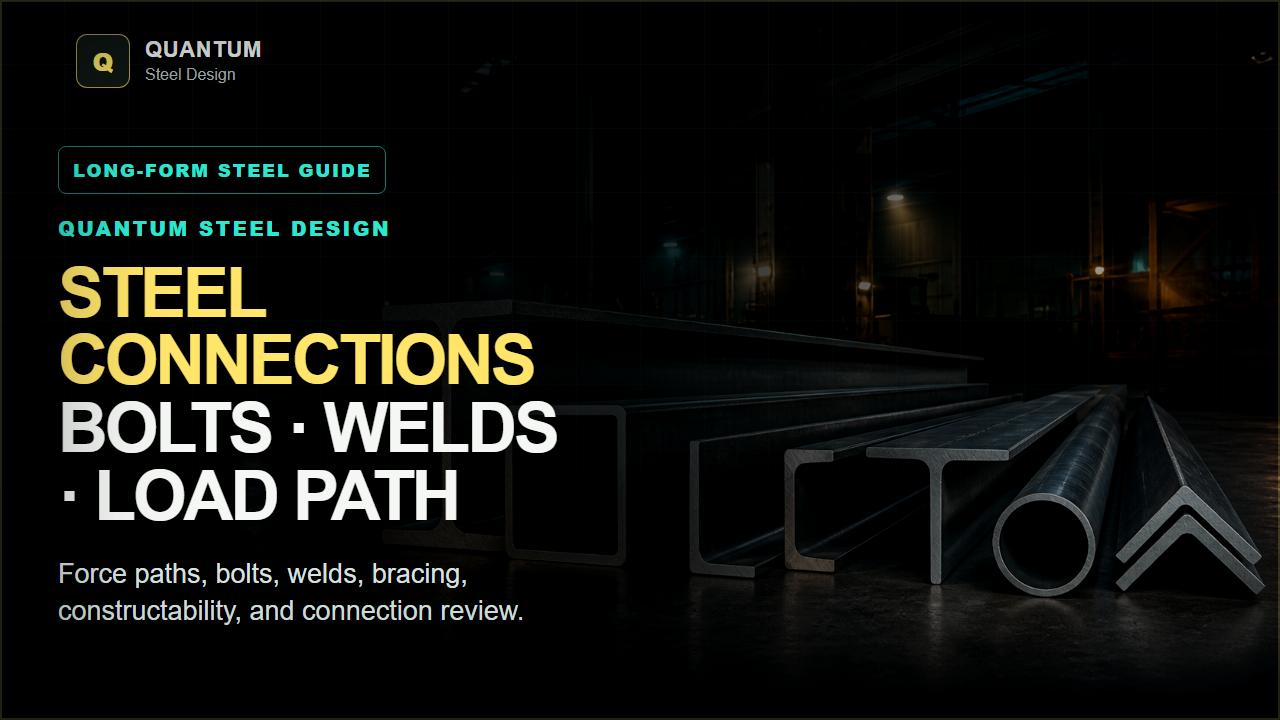
Learn structural steel connection fundamentals: load paths, shear, moment and brace connections, high-strength bolts, welds, detailing, inspection, and constructability.
 11:50
11:50
Coordinate steel submittals, review comments, RFIs, revisions, partial releases, and fabrication data with a clear source baseline and documented handoff.