 0:55
0:55
Why Blank Steel Data Is Not Zero
Learn why blank, zero, unknown, and not-applicable are different data states—and how silent conversion can make incomplete steel information appear valid.
Steel video · 0:47
Decode the L4x4x1/4 equal-leg steel-angle designation, including leg dimensions, thickness, nominal weight, orientation, and connection considerations.
Practical context
Because both legs are four inches, this is an equal-leg angle.
Use the actual shape properties and the contract documents for fabrication and design decisions.
Companion reading and practice
The equal-leg angle label describes nominal leg dimensions and thickness. It does not state which leg is connected, the connection geometry, or the member’s orientation in an assembly.
Use the reference record for geometric properties and the project drawing for placement and connection requirements. Axis and centroid conventions need particular attention for angles. A simple profile is useful for identification but does not establish member or connection capacity.
Sketch the orientation from a sample detail, then compare it with the reference profile before copying any property.
Examples are fictional learning exercises. This companion text adds context to the video; the transcript below records the narration.
Primary sources
Use the edition and requirements adopted for the project. These references support further reading; a short video does not reproduce the complete standards.
Published by Quantum Steel Design. Sources and editorial approach · Report a correction · Companion guide updated .
Accessible transcript
The visible transcript makes the video content available to people and search systems without requiring playback.
Keep watching
0:55
Learn why blank, zero, unknown, and not-applicable are different data states—and how silent conversion can make incomplete steel information appear valid.
 0:55
0:55
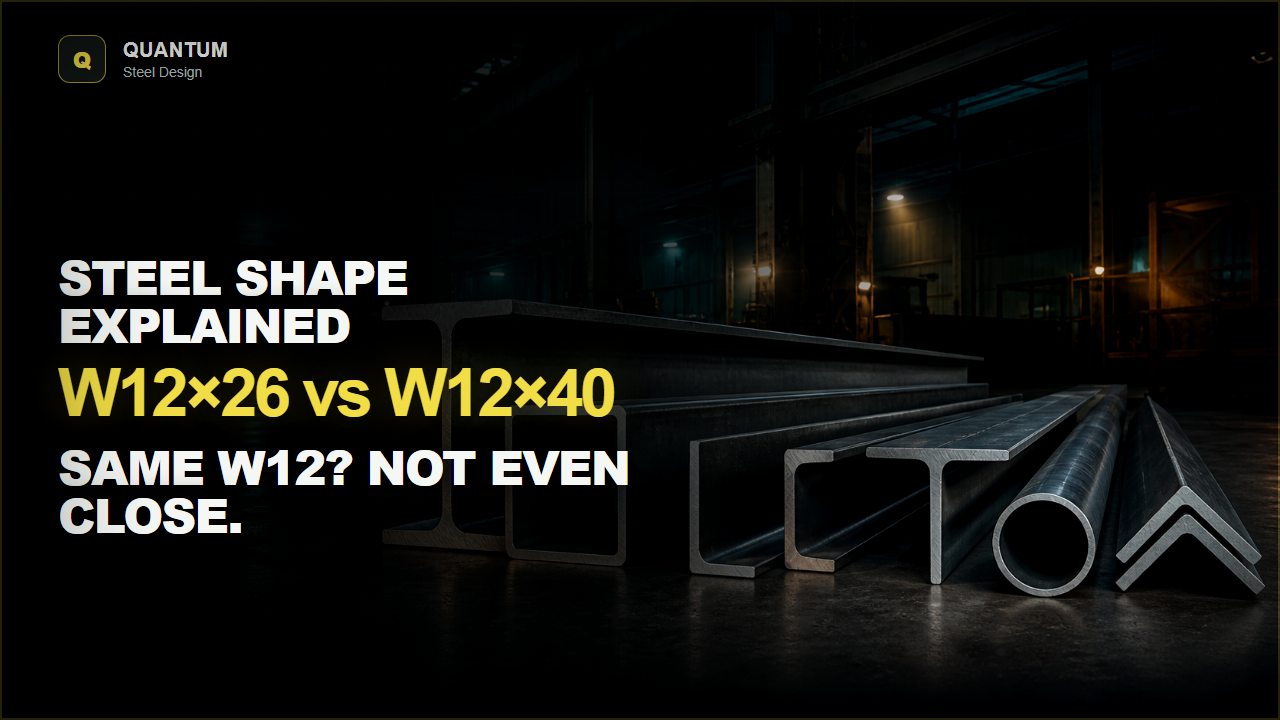
Compare W12x26 and W12x40 dimensions, weight, flange width, stiffness, and connection implications before treating two W12 beams as equivalent.
 0:48
0:48
Decode the 2L4x4x3/8 double-angle designation and understand why separation, connectors, eccentricity, and stability define the built-up member.